
Toward a Nomad Web
A Brief History of the Internet's Enclosure and the Conditions of Its Release


Produced along the vectors of the Open Machine, where more research and writing like this is taking shape.
“’Nomad thought’ does not immure itself in the edifice of an ordered interiority; it moves freely in an element of exteriority. It does not repose on identity; it rides difference.”
— Brian Massumi, Translator’s Foreword, A Thousand Plateaus
“The law locks up the man or woman /
Who steals the goose from off the common, /
But lets the greater villain loose /
Who steals the common from the goose.”— Anonymous (English, c. 17th–18th century), on the enclosure of the commons
The history of the internet can be read as a long oscillation between two kinds of space, a plane of movement and territory of capture — what Deleuze & Guattari call smooth and striated space [1], or nomad and sedentary space, respectively. Striated space is the space of the State: gridded, metered, governed, organized around fixed points and the regulated channels between them. Smooth space is the space of the nomad: occupied by movement rather than settlement, held by trajectories to which points are subordinate. The nomad, in their usage, is not simply a wanderer but a figure of exteriority — holding life outside the State apparatus, beyond its comprehension; its capacity to overcode its modes of relation. Nomad and sedentary are not geographic terms but name two tendencies present in any field, technical as much as socio-political, and the two exist only in mixture, the ground of each constantly being turned over into one another.
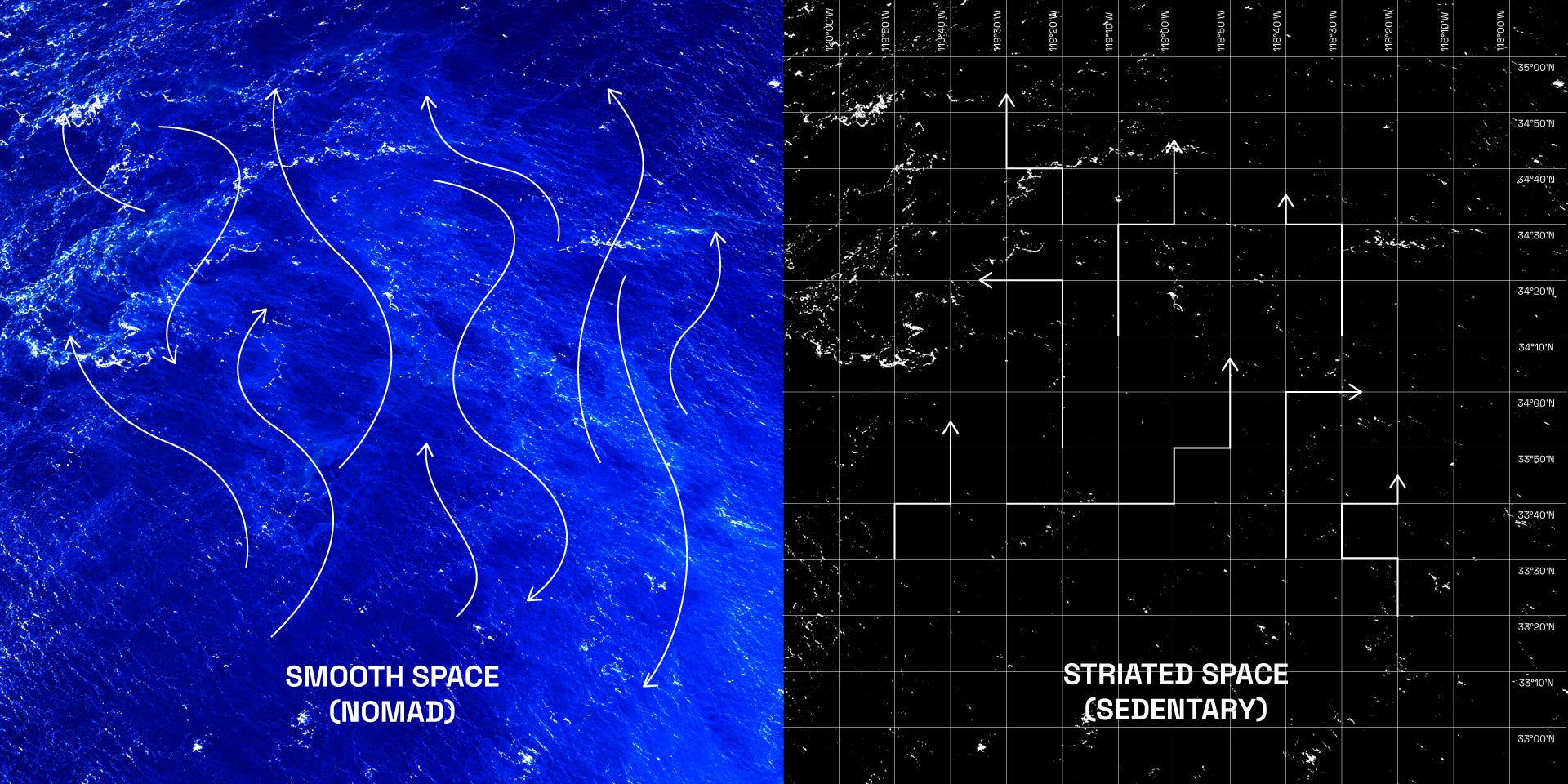
The early protocol web, oft referred to as web 1.0, was a smooth space — a nomad space. A flat terrain, a desert, that had yet to be terraformed by capital. It was a composition of open standards for the elementary relational modes of networked life, the publishing, distribution, discovery, and exchange of information. Then came the march of platforms, web 2.0, striating the space into one dominated by intermediating settlements. The platforms deterritorialized the flows of that pure, pluralistic utility demonstrated by early protocols and reterritorialized it onto a surface owned and operated by platforms. Once networks effects had produced sufficient lock-in, what was a plane of movement progressively striated into an apparatus of capture, the platform-State. Doctorow names the terminal phase of this cycle enshittification [2]. A recurring pattern runs beneath every episode: the communities formed the trust and the relationships, but a platform owned the rails that routed them. The platform-State, like any other State, is a mode that limits all other modes of relation — modes of organizing, communicating, exchanging.
What survives the cycle, precipitating outside of it rather than perishing within it, is an emergent social form I call nomad publics [3] — distributed multiplicities held together not by membership but by acculturated semiotics – shared aesthetic grammars, epistemic craft and vernacular. Though platforms often open up pathways for them to consolidate, nomad publics pre-exist them. They are defined by their capacity to disperse and recompose on new surfaces, to hold a territory through movement rather than settlement. Publics constituted in exteriority to the sedentary space of the platform-State, which functions as the State-apparatus of the web. They are not nomad in a geographic sense, though movement and exit to exteriority are important attributes. The problem is that movement and exit, at present, are ruinously expensive. Each line of flight — Deleuze and Guattari’s term for the path out of a striated arrangement — costs the public its coherence, which it must reassemble almost from scratch on whatever surface it next finds compatible with its modes of relation. The process of dispersion and reassembly is not immediate, and the spatio-temporal gap between them is a vector of vulnerability.
Beneath the striating mode of platforms lies a more universal phenomenon of networks — preferential attachment [4], the tendency of networks to route new connection toward that which is already-connected. Platforms did not invent the inequality of attention; they industrialized it, capturing pre-existing network effects to extract the differential. Preferential attachment happens at two scales: users flocking to platforms as well as attaching to popular users within a platform. To make this nomadic line of flight survivable is therefore not to abolish a universal dynamic, but to refuse any single party the ownership of it, the centralized enclosure common in the platform-State. This essay will argue that there are new capabilities granted by hindsight and emerging technologies today that may lay out a path to a radically reimagined web — one that rebalances the trades that the entire history of platforms was built on: convenience purchased with control, sovereignty traded for reach. The nomad web is an operating model of a future internet composition where no incentive topology is permanent, no intermediary is load-bearing, and exit is always cheaper than capture.
Part I - The Protocol Web and its Genesis
“if we wish to define the laws of the genesis of a technical object within the framework of its individuality and specificity, we had better not begin with its individuality or even its specificity but, rather, reverse the problem. If we begin with the criteria of its genesis we can define the individuality or specificity of any technical object.”
— Gilbert Simondon, On the Mode of Existence of Technical Objects
The philosopher of technology Simondon says that to understand a technology, we must understand its genesis, its process of becoming [5]. To analyze only its current being is not enough. We must track the integral situations that led to its concretization — Simondon’s term for the process by which a loose assembly of elements become individuals and settle into a coherent, self-reinforcing ensemble. So we’ll start here, at the emergence of elementary particles, at the birth of the web and its precondition. It’s important to understand that the early web was a composition of protocols developed and in use prior. Even before the protocols there was the network itself. ARPANET, funded by the U.S. defense research agency [6] and switched on in 1969 to link together a few research sites, was built for resource-sharing on a decentralized topology with no central point of control. ARPANET established the network; TCP/IP (1983) made it an inter-network of networks. TCP (Transmission Control Protocol) handled breaking data into packets, ensuring they arrived reliably and in order; IP (Internet Protocol) handled addressing and routing those packets to the right destinations. UseNet, a protocol of forum style discussion, was conceived in 1979 with the first message sent in 1980. SMTP, the open standard for email, came about in 1982. FTP, the file transfer protocol, stabilized into its enduring form around 1985. IRC, the chat protocol, arose in 1988. The protocol web is what was built atop this foundation, inheriting its decentralization — and layering on an attribute of ownerlessness [7].
By the mid-1980s the growth of Usenet led to a contention over naming rights, and across 1986–87 the network reorganized itself in what came to be called the Great Renaming [8]: the sprawling net.* groups were sorted into a small set of top-level hierarchies — comp, sci, soc, talk, news, rec, misc — known as the Big Seven (later the Big Eight, once humanities was added in 1995). This was a striated space the commons built upon itself. A new group could be created only by running through a gauntlet of governance: a Request for Discussion, a period of debate, then a Call for Votes that the proposal had to win by at least a hundred net “yes” votes and a two-thirds majority. The renaming was overseen by the loose group of major site administrators sometimes called the Backbone Cabal, whose perceived overreach and control became a grievance that produced an “escape hatch”.
After John Gilmore’s proposed rec.drugs was refused and the supposedly free-speech talk.drugs was denied, an alternative was sketched out at a barbecue in Mountain View, named simply alt.*. Alt was ungoverned, with no cabal or voting. Anyone who could technically issue a control message could start a new group. Without centralized control, propagation was a matter of each server admin deciding which alt groups to carry. A group you couldn’t reach hadn’t been deleted by an authority, but simply wasn’t carried. What alt became is the home for everything the Big Eight hierarchy couldn’t or wouldn’t host, from the cult devotion of alt.tv.twin-peaksto the vast alt.binaries groups that turned Usenet into the era’s engine of file-sharing. The FAQ of alt expressed its own affectionate gloss that “alt” really stood for “Anarchists, Lunatics, and Terrorists.” The Big Eight was striation from below, the commons gridding its own space — proof that striation is not something capital does to a commons from outside but a tendency interior to any space — and alt.* was a line of flight in its purest form, a smooth space opened inside the very system that was striating itself. In a single system, pre-internet, Usenet ran both spaces, nomad and sedentary, simultaneously, in mixture.
The world wide web would come soon after, born as an argument against the observed limits of hierarchical information. In the first sketch of what would become the web, “Information Management: A Proposal” [9], Tim Berners-Lee described a way for the sprawling research organization, CERN, to keep track of itself and the rich intelligence produced within it. He observed that CERN’s modality of life was not its org chart but “a multiply connected ‘web’ whose interconnections evolve with time.” Information was difficult to find, and getting lost. Within the proposal, he laid out the design principles that would enable the organization to better publish, distribute, and make discoverable its corpus of knowledge.
The configuration of storage “must not place its own restraints on the information”. On non-centralization, he says “Information systems start small and grow. They also start isolated and then merge. A new system must allow existing systems to be linked together without requiring any central control or coordination.” The conclusion opens with “We should work toward a universal linked information system, in which generality and portability are more important than fancy graphics techniques and complex extra facilities.” Berners-Lee had essentially made the case that the infrastructure must be nomad if it were to be wise. CERN approved the project and the rest of the core protocols of the internet followed — WWW, HTTP, HTML, etc — bringing into form the first full infrastructure of the internet. The web grew in use amongst its early community and a few years later in 1993, Berners-Lee would push CERN to relinquish all intellectual property rights to the web and release it royalty-free, having watched the University of Minnesota try to charge licensing fees for the rival Gopher protocol and seeing the internet quickly abandon it in disgust [10]. It was a deliberate act of keeping the ground smooth, and one of the few moments in this history where smoothness was chosen rather than merely inherited.
The web exploded with content, scaling rhizomatically in all directions. But human curation scales linearly with human effort while the web scaled out exponentially, and the gap between them led to defeat by complexity. With so much content on the web, webrings [11] emerged in 1994 as a protocol to address the discovery problem with vouched, topical curation. Volunteer ringmasters approved sites within a ring based on relevance, and members embedded a script that passed visitors on to relational neighbors — next, previous, random, hitting next enough times returning you to the start, completing a “ring”. Curation was reciprocal endorsement, without rank or algorithm. But the routing ran through a single script which became a company. Sage Weil wrote it in 1994 and incorporated WebRing in 1995, then sold it to Starseed in 1997. GeoCities acquired it in 1998 but changed nothing, leaving the original system and ringmaster autonomy intact. The capture, and enshittifcation, came with the next link in the chain. Yahoo acquired GeoCities in 1999 and overhauled the system as Yahoo! WebRing in 2000 which now required a Yahoo account, stripping ringmaster control, and — lacking verification — let the first claimant seize a ring out from under its creator. Ringmasters lost their own rings, and the publics migrated. They had owned the trust and the relationships, but not the rails that routed them.
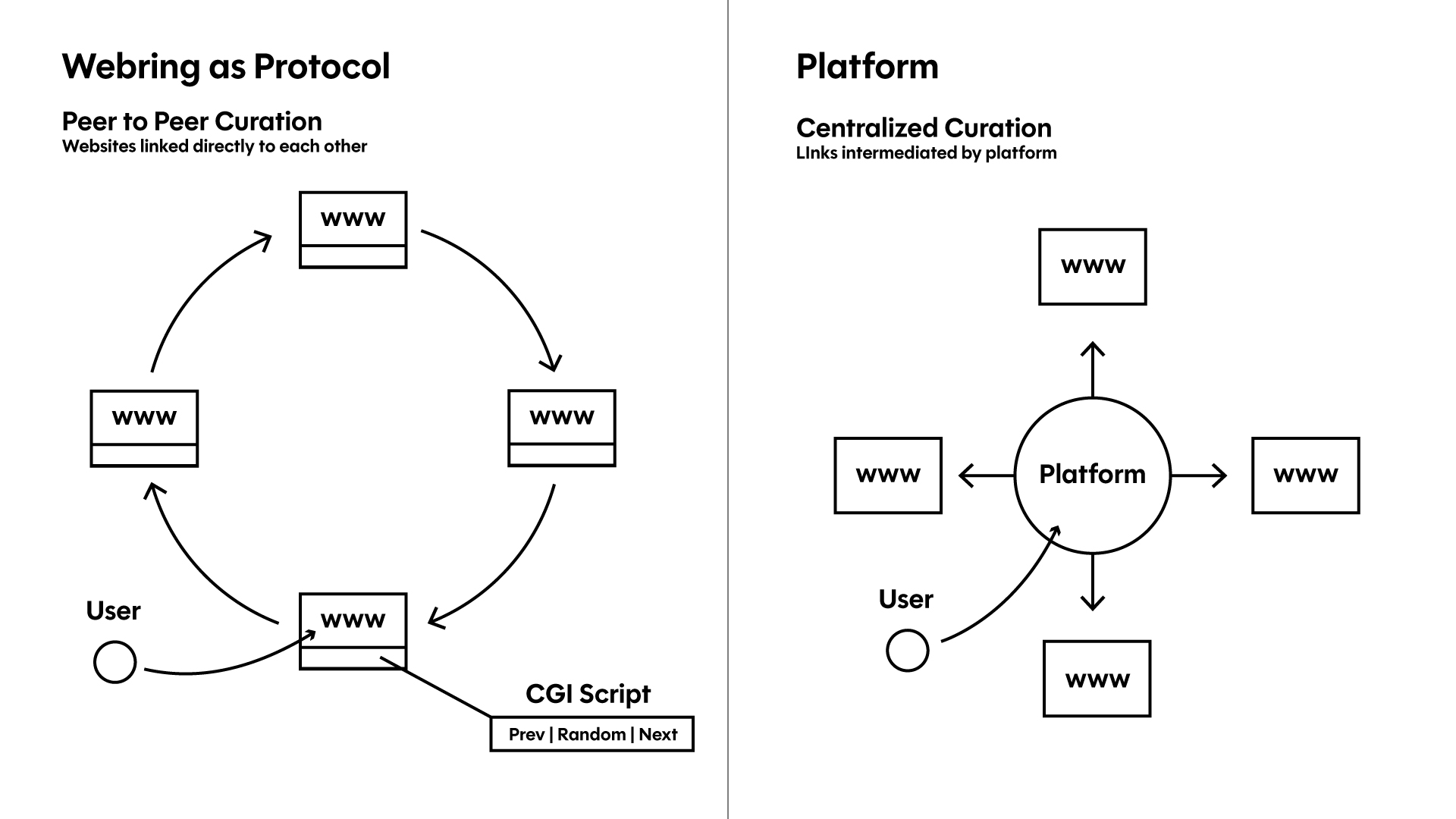
The hand-built directories told the same story on a different surface. GnuHoo arrived in 1998 as the open-source answer to Yahoo’s understaffed, languishing catalog — its premise that tens of thousands of volunteers could hand-curate the web faster than any paid team. Fittingly, its founders came out of Usenet — Rich Skrenta had written a Usenet newsreader — and GnuHoo borrowed its ontology straight from the newsgroup hierarchies, the same taxonomic impulse migrating from Usenet into web curation. The name churned under pressure from both sides: the Free Software Foundation objected to “Gnu,” forcing a rename to NewHoo, then Yahoo objected to “Hoo” — before any further change, Netscape acquired it and rebranded it the Open Directory Project, hosted at directory.mozilla.org (hence DMOZ). Netscape was soon absorbed by AOL, folding the great volunteer directory into a browser acquisition, under the control of the era’s archetypal walled garden. Webrings and DMOZ were the two great hand-curation experiments of the same window, and they met the same end twice over: defeated by a web scaling exponentially against curators scaling linearly, then enclosed by capital — WebRing into Yahoo, DMOZ into AOL. The curatorial commons could solve discovery, but not maintain control over the ground it stood on.
In Simondon’s vocabulary, this was the era of elements: protocols as discrete technical individuals-in-waiting, loosely composed, not yet concretized into the ensemble that would later govern them. The protocol web was smooth by inheritance, not by defense. Its openness was a property carried over from the resilience engineering of a military network and the institutional generosity of a research lab; nobody had built it an immune system against striation, because nobody had yet imagined the apparatus that would striate it. The webrings’ random button and Berners-Lee’s royalty-free release were gestures toward such a defense, but gestures only. An undefended smooth space is an invitation for capture.
That invitation was accepted, by both demography and capital. Perennially, new users would pile into Usenet every September, when students would arrive on campus and get access to their university accounts; the culture of netiquette absorbed each cohort in turn. In September of 1993, commercial Internet Service Providers — America Online above all — would release Usenet access to their massive user bases. This spawned an onslaught of new users so overwhelming, on such a runaway trajectory of growth, that this period, has been called the “September that never ended”, or the Eternal September [12]. The flood did not merely strain the internet’s acculturation; it changed who it was for, and what they would first encounter when they arrived. Most of them would never meet the protocol web at all.
Part II - The Rise of the platform-State as Ensemble
To translate this into a temporal mode: capitalist saturation of our social space by consumerism steals the present away from us; it deprives us of time, while offering all sorts of technological gadgets that promise to save us time. It is a system that arrests the flows of becoming, freezes the rhizomic propensity for multiple connections and expropriates nomadic intensities through quantitative build-ups of the acquired commodities.
Rosi Braidotti, Transpositions: on Nomad Ethics [13]
Riding the wave of the Eternal September, most people never encountered the web as protocols, but as product. AOL was a walled garden that bundled access, curation, and discovery into one mediated, convenient experience. The mass user was handed the cathedral and never told there was a bazaar — and so capture was not a felt betrayal but simply the default mode of arrival. This is the pattern every later platform repeats: capture a layer by enclosing its only legible interface. Each solved a real problem of distribution or discovery, and each came to own the layer it solved. The value was genuine — access, then discovery, then reach and payment at scale — but ownership of that value let the platform monopolize the interface, and subsequently the modes of relation. Protocols, for their part, rarely die outright; they recede, and reemerge in altered form when a niche reopens — a reemergence we will visit in the Part III. The platform-State concretized itself over a long series of captures.
Google captured discovery. Its first offering, the PageRank algorithm, ranked pages by their inbound links, reading the protocol web’s existing link graph as a tally of votes: already-linked pages ranked higher, ranking drew more links, more links drew more ranking — preferential attachment productized. Google did not invent the concentration; it merely measured it and fed it back, amplifying it. The value was real, relevant results instantly at a scale no hand-built directory could reach, but “just Google it” made one company the default mode of discovery, allowing them to become the arbiter of what would be seen on the web. With sponsored results, rank became a commodity — the layer that decides what is seen now charged for it — and SEO emerged to game it. This is a textbook instantiation of Goodhart’s law: once rank was the target, rank ceased to be a measure of worth (discovery). The same fate took RSS, the last reader-controlled protocol of discovery: once Google Reader concentrated it into a single client and then shut that client down in 2013, the public scattered not back to the protocol but into the algorithmic feeds, where once again what you saw became someone else’s decision.
Facebook and Twitter captured the social graph and the public square. Where Google indexed pages, Facebook captured the relationships between people, held within one database. The News Feed (2006) converted that graph into an algorithmic push: you no longer chose your sources, the feed chose for you, ordered to maximize engagement and ad revenue — reader-controlled pull inverted into platform-controlled push. The graph that had been a commons of relationships became an asset the relationships could not leave, since exit meant abandoning your contacts. Where once we held someone’s email or phone number, a contact we owned, we now asked to connect on Facebook. Twitter ran the same maneuver on real-time public discourse, the function Usenet and IRC had served as open protocols, permitting pseudonymity but owning the follower graph and the controlled the algorithm that defined reach. That the public square was never the public’s became plain the moment its ownership changed, and the rules of attachment changed with it.
Reddit and Discord captured community. Usenet’s newsgroups and IRC’s channels were topical community as open protocol — federated, ownerless, governed by their own participants. Reddit rebuilt that structure inside a single company: the same topical rooms, the same volunteer moderators performing the unpaid curatorial labor the commons always ran on. Until, ahead of its 2023 IPO, it priced out the third-party clients its communities depended on, and the moderators revolted by going dark, a publics forced to reconcile all at once that they did not own the spaces they had built. Many communities migrated to Discord, where the trap was already being reset: real-time community with better tools and no exit, years of conversation and relationship poured into a walled, unportable, sedentary silo. The function of community that Usenet had served as protocol, the platforms now held as property.
Substack, Spotify, and Youtube capture the creator-audience relationship itself, and it runs along a gradient of how much sovereignty the platform pretends to concede. Substack offers the most — own your list, leave with it — while keeping control over the payment, discovery, and recommendation rails. Spotify concedes less, owning distribution, discovery, and the rates that set what an artist earns. YouTube concedes nothing: the algorithm sets reach, corporate policy sets income, and the audience is wholly unportable. Across all three the pattern holds — “own your audience” is hollow when you do not own the rails that route you.
The latest capture is happening at the human-ai relationship. OpenAI, the operator of ChatGPT, started as a non-profit but quickly switched to a profit-seeking model once the gravity of its chat bot was observed as a useful moat to generate extraction, starting its yield clock. The emergence of the ai chat bot has led to the fastest accretion of user data into centralized databases in history. Where Google owned discovery and Facebook owned the graph, the AI assistant aims to become the single mediating surface beneath all of them — the one interface through which search, correspondence, community, and creation are conducted. The informational material it uses has been scraped from the web and turned into training data and sold back to its authors as a service — the commons becoming raw input to the engine of its own displacement. The technology’s move is a radical deterritorialization and there may be ways to invert its capacities against the platform-State that we’ll get into later.
Across discovery, the graph, community, and the creator relationship, one structure recurs: a real problem solved by a platform that comes to own the layer it solved, then extracts once lock-in is complete — driven not by villainy but by an asset’s predictable maturation under capital’s demand for yield, a schedule set not by the intent of the builder but by the mechanism of return and capital appreciation. When discovery, discourse, community, and livelihood all run through platforms whose teleological trajectories are shareholder revenue, the platform occupies the position of the State: it striates the space, coding its rules, governs what may be seen and said, and taxes the flows. This is how we arrive at a platform-State — an ensemble of protocols and platforms concretized into an ever-homogenizing mode of social production at the behest of capital. The platform-State is always expanding its grasp and control over the modes of relation. But runaway striation builds the conditions for its own resmoothing: like a volcano, pressure accumulates beneath the surface until the structure inevitably ruptures, sending ejecta into the surroundings.
Individuals and communities do exit the platform-State, by force and by principle. By force when the IRC network Freenode, the real-time backbone for free-software projects since 1995, was taken over by an owner the volunteers no longer trusted, its senior staff resigned en masse in May 2021 and stood up a new network, Libera.Chat, on infrastructure they held themselves. Within weeks Ubuntu, Fedora, Arch, and hundreds of other projects followed. What made the flight survivable was that IRC was an open protocol anyone could re-implement. By principle when the post-rationalists (”TPOT,” This Part of Twitter) dispersed across independent Substacks, older blogs, group chats, and in-person gatherings, deliberately keeping themselves illegible to avoid capture by the platform’s mob — an” old political strategy” [14] of marginal peoples to remain ungovernable. These are nomad publics: held together not within platform-controlled relations but by shared aesthetic grammars, epistemic craft, and vernacular. There is an unknown number of nomad publics operating outside the platform-State, immeasurable by nature — fractured, mobile, and exterior to the very metrics the platform-State instrumentalizes for its apparatus of capture.
Two concepts name the shape of the escape. Yancey Strickler’s dark forest theory of the internet [15] holds that the open, searchable, algorithmic web has become hostile terrain — a place where to be visible is to be targeted by advertisers, trolls, surveillance, and the flattening pressure of engagement metrics — so its inhabitants go quiet on the surface and move into its shadow. This destination is what Venkatesh Rao calls the cozy web [16]: a layer of gated, un-indexed, semi-private spaces beneath the public internet — group chats, newsletters, Discord servers, Slacks, gated forums — passage into which is granted by invitation or trust rather than routed by the platform-State. The cozy web is illegibility chosen as refuge to exit beyond the platform-State’s comprehension. But the refuge is not yet a line of flight. The publics of the cozy web still inhabit ground they do not own, a rug that can be pulled out from underneath them at the will of the platform, forcing yet another migration. This is an unstable territory. It escapes visibility only to land inside another enclosure. These publics deserve a space where their modes of association can compound and accumulate without the fear of an impending decoherence. The gap between refuge and sovereign ground is the gap the nomad web sets out to close.
Part III - The Resmoothing, a Protocol Response
“ consolidate that territory by the construction of a second, adjacent territory; deterritorialize the enemy by shattering his territory from within; deterritorialize oneself by renouncing, by going elsewhere . ... Another justice, another movement, another space-time.”
— Gilles Deleuze & Félix Guattari, A Thousand Plateaus
A resmoothing of the internet is already underway, as it’s always been, in the form of a protocol response to the platform-State. Deleuze and Guattari insist that the two spaces, nomad and sedentary, exist only in mixture. Striated space is constantly being reversed, returned to smooth space, even as the smooth is translated back into the striated. The protocol response in motion now is therefore not a contingent activism but a structural tendency — the smooth reasserting itself at the seams of the apparatus, in the niches the ensemble cannot see due its myopic focus on profit. Protocols never die, or go fully extinct. They reemerge, in altered forms, when opportunity breaks, a new niche to seep into. The resmoothing has, in this sense, always been unfolding in response to striation. “This time is different” as we love to say. The protocol web inherited its smoothness, carried forward by builders who hadn’t yet imagined the apparatus that would come to enclose it, and so built no defense. The protocol response is different though, in that it is smoothness engineered. Builders who have watched the full cycle of capture play out have internalized its lessons into an immune response that the protocol web lacked — antibodies raised against a pathogen. And it aims to defend against capture on two fronts at once: its mechanism, the centralized enclosure of a dependency; and its motive, the capitalized enclosure in search of yield.
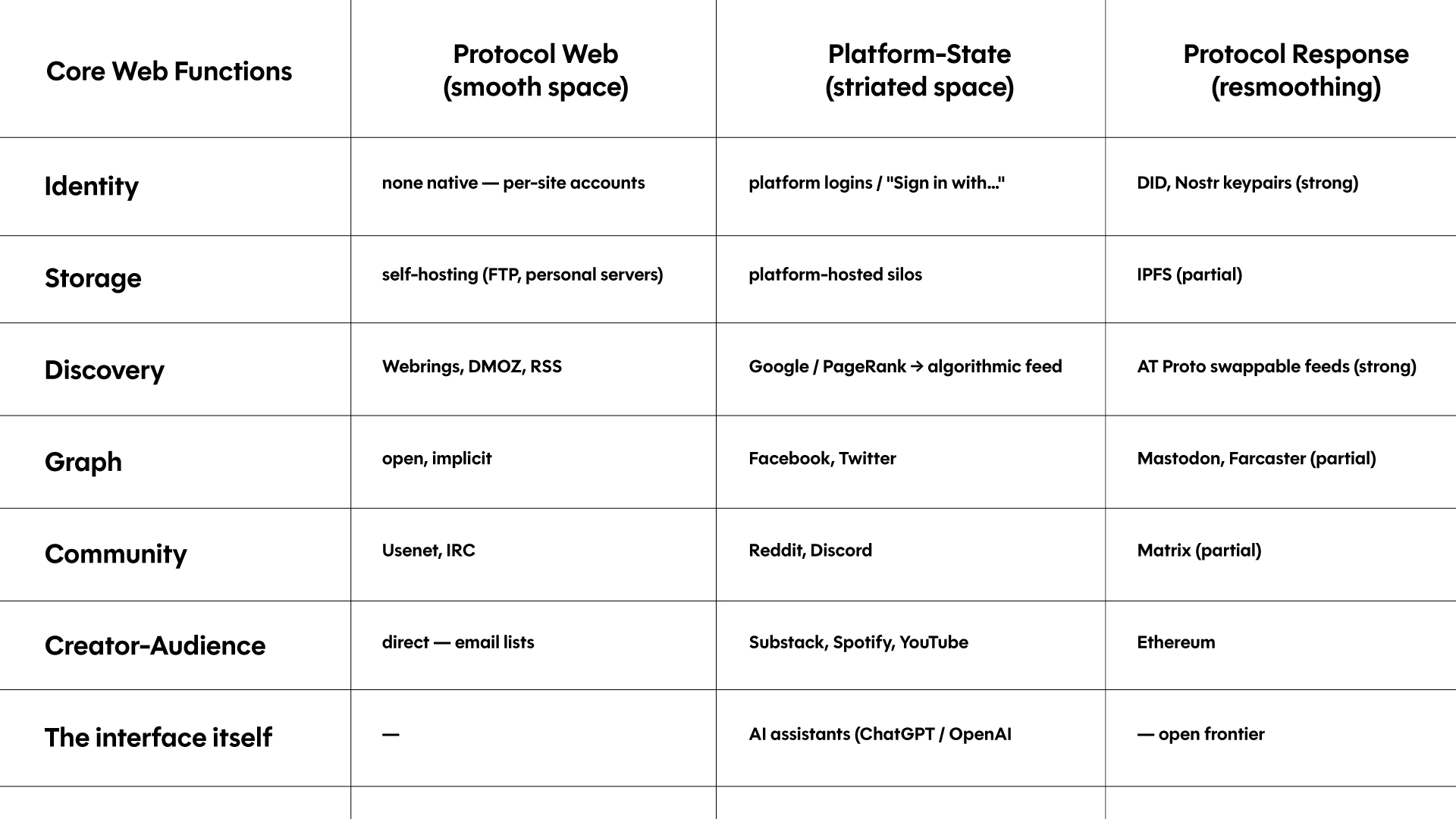
Take the mechanism first, as this is where protocols are genuinely clawing back territory from the platform-State. The layers that have been captured by platforms can be viewed as the necessary functions of the internet, and it’s here the protocols have focused their attacks - to dissolve the platform-owned dependencies. The public square is being re-federated with discourse running across independently operated servers (ex. Mastadon [15]). Community also has self-hostable solutions (ex. Matrix [16]). These options trade operational burden and discovery for sovereignty. The graph is the most complicated, coming from maintaining a map of the relations in a graph, but the edges are identity to identity, and there are a slew of open standards for decentralized identity, an identity that is a cryptographic key one generates rather than an account issued by a platform (ex. Nostr, DID [17] [18]). Some protocols allow for a graph that travels between hosts rather than living captive in a single company’s tables. There are protocols of single-sign on and authentication that build on the identity domain that also remove the need for platforms to own login. Some platforms have opened their authentication, ceding their ownership of account, based on user demand. In the domain of platform-owned content, there are protocols like IPFS [ref] that allow for peer-to-peer hosting of content, removing the ability for platforms to lock content on their servers. Discovery, which Google captured by owning the ranking, is being pried back open by making the ranking algorithm a swappable service chosen from an open marketplace rather than a platforms’ black box — with tens of thousands of such feeds already in use (AT Protocol [19]). The through-line is consistent. Where the platform-State captures a layer by owning its infrastructure, the protocol response reclaims territory by making the infrastructure belong to no one — refusing any single party ownership of the routing mechanism, the rails, countering the precondition of enclosure.
Where the resmoothing has not yet retaken territory, where no protocol response has yet matched the platforms, are the values of creating reach and capturing value. These two are still the core value people receive from centrally-owned platforms, that keeps them locked in. Along with the issue we covered earlier about the graph of relations, the container of network effects that animate reach and value. Blockchains like Ethereum introduce protocols of peer-to-peer payment rails that could in theory reclaim the territory of the creater-audience relationship, making it a peer-to-peer relationship, as opposed to one intermediated through a platform. Though no prominent applications of it have sustained. Farcaster protocol uses the Ethereum blockchain underneath to give users sovereign ownership of identity, the graph, even a wallet which allows users to directly send payments to each other. The protocol raised $180 million and spent five years building a decentralized social protocol, but in January 2026 the founders would return the entirety of raised funds back to their investors, citing dwindling usage [20]. They practically gave the protocol to the infrastructure firm who had been working on its infrastructure. This protocol approach to platform design allowed the network to survive the handoff, and it’s still operational, but it failed to hold a public. Even with the combined sovereignty of identity, the graph, and payment rails, the lure of reach on incumbent platforms was too high a cost for users to truly migrate away.
The lesson here is an important one. Social platforms still win on incumbency — the network and your contacts are already inside. To move out, the switching costs are simply perceived as too high. The cold start problem is a real one. In the early days of the smooth protocol web, it was all a cold start so there wasn’t any incumbency to compete with. Today, simply copying the mode of an incumbent, but with nomad infrastructure underneath, isn’t enough to overcome it. One way the cold start problem has been addressed is by producing a genuinely new type of interaction, such as twitter and instagram’s constrained interactions, a limit of 142 characters and a focus on images respectively. These novel interaction schemas were enough of a lure for users to be okay with the cold start problem. A similar issue also arises at the lower scale in federated self-hosted systems for communities, where attention often gravitates toward a few large servers. Preferential attachment leads to incumbency at all scales of networked space.
The resmoothing is not the result of a single project but a wide and uncoordinated field — non-profit organizations and foundations [21, 22, 23] , independent standards bodies, research labs, and countless individual builders, each working with a different theory of how the next internet will concretize. The field of a parallel web universe has grown large enough that some have taken to mapping the ecosystem of protocols and technologies, to show it as a living, interconnected body [24] with a telos of nomadism instead of yield. The map reveals the honest state of the resmoothing. It is not a finished alternative, not a single contender poised to replace the platform-State, but a sprawling, redundant, partially overlapping commons of attempts. This is exactly the rhizomatic, all-directions growth the protocol web exhibited at its genesis, now with the gift of hindsight, being raised with a defensive mindset [25] rather than a naive optimism. A major gap in service of protocols is the lack of connective tissue between them. There is no coherent assembly of protocols that a non-technical public could actually inhabit without stitching the substrate together themselves, which requires a combined abundance of desire and technical expertise. The mechanism of escape exists in parts, but does not yet exist as a space to inhabit.
For the next internet to emerge as a durable alternative to the platform-State, we need to first internalize the lessons of the internet’s genesis and capture. From that ground we can produce assemblies of protocols and applications that provide surfaces that can exceed the value of platforms, while holding the attributes of nomad infrastructure underneath all the way down. The onus isn’t solely on developers to build suitable tech but requires massive scale cooperation with users, who need to take the gamble and weather the storm of the cold start. This cooperation can lead to the formation of new networks of relation, this time with portable identity and graphs, intentionally sedimenting into a nomad space, immune to enclosure and free to move and feel out the potentials of sociality.
Part IV - The Vectors of Enclosure and a Strategy by Negation
A Diagnostic Toward an Internet Reimagined Based on its Genesis and Modern Capacities.
“Once the technical object has been defined in terms of its genesis, it is possible to study the relationship between technical objects and other realities ...”
— Gilbert Simondon
“The assertion that a particular technical object is a tool or a weapon depending on the larger assemblage of which it is a part could then be interpreted as meaning that a knife as used in a “kitchen assemblage” is a tool, the assemblage selecting from all its capacities only the ability to cut, while the same knife in an “army assemblage” becomes a weapon, the assemblage selecting its ability to kill”
— Manuel Delanda [26]
We have traced the internet’s genesis — from elements (protocols), to individuals (platforms), to concretized ensemble (the platform-State) — and we have observed the modern protocol response: a distributed substrate resmoothing the internet layer by layer. We are no longer imagining the apparatus of capture. We have witnessed and studied its assembly, and we now know its anatomy, its tendencies of becoming. The protocol web fell not because it was open but because its openness was left undefended: smooth by inheritance, it had no immune system against striation. The nomad web begins from the inversion of that condition, with the lessons learned from various capture modes of the platform-State and the protocol response. Its smoothness must be engineered — striation-resistance not a property we hope is maintained by benevolent stewards (spoiler: it will not be) but an explicit design requirement. As showed in the protocol response, there is a distributed abundance of protocols that meet this requirement at technical level. However, the technical attributes, no matter how hardened, won’t matter if sufficient gravity cannot be generated to illicit a migration from platforms and the greater forces of capital enclosure. For the nomad web to not only survive but persist into the future, it must contain a robust immune system that offers defenses against both migration costs and the vectors of enclosure.
Before we can engineer against enclosure, we have to locate its vectors. Enclosure happened in a multitude of ways throughout the internet’s history, and capture, in all cases, happened via the centralized enclosure of a dependency. How a dependency came to be is just as important as how it was enclosed. Let us take an overview of the full cycle, from our tower in the sky. A cycle starts with a novel solution to a common problem that creates gravity which grows into network effects as news of the solution spreads. The attention of the many is pulled toward its center until the solution effectively becomes a dependency. Capital observes this compounding social viscosity, the accretion of human attention around a behavior, and purchases the ground on which it takes place. An exchange accepted because builders need resources to keep up with the increasing demands of the gravitated network. This is enclosure, and wherever it is incomplete, a line of flight still available, capital seeks to further restrict movement toward its outside, the exit condition necessary to be nomad. Not to act as some malevolent conqueror, but to simply fulfill its promise, to maximize its yield over time, the primary tendency embedded in the conatus [27] of capitalism. This is the natural history of how the process unfolds, but of course over time it has matured toward efficiency, into an engineered process, with capital crawling down the stack to inject itself earlier and earlier in the process, staking their territory, starting the yield clock, long before network effects are realized, only forecasted in a pitch deck.
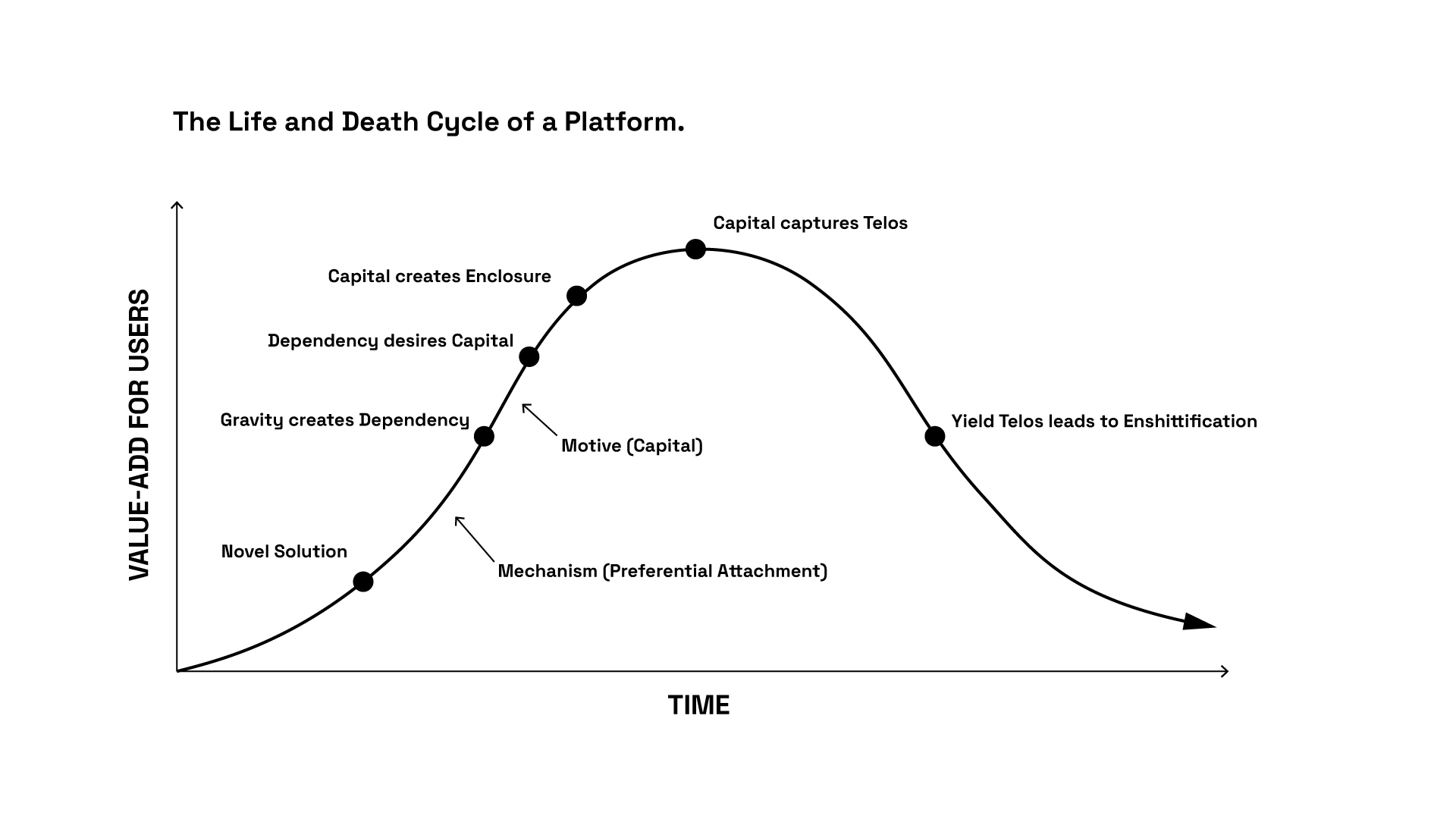
This cycle has replayed in all stages of the web thus far and matured greatly — though not toward a better internet experience, but one toward a more efficient extraction of capital. Every transition point is a tendential climbing of the stairway to capture. We can in theory address the issues of this cycle by intervening at any of the transition points. The first transition point is where we start our diagnosis — where a genuinely novel solution to a common problem produces gravitational effects that pulls a public’s attention toward a center. There is a true compounding of value observed by network effects, more usage creating more value, so this doesn’t seem an effect to defend against. This centering effect creates the tendency toward the next transition, becoming a dependency, the lock-in, the preconditions for capital’s takeover. The lock-in is first social before it is enclosed by capital, driven by observation of real value. But this is also where we should start to become wary, as it’s a sure bet that capital has also seen this lock-in and will move to capitalize and enclose the territory, prepping it for efficient extraction. The dependency, through the lens of capital, is not a community but a moat, a defensible asset, and capital is simply the thing that flows toward defensible assets in search of yield.
In Doctorow’s Enshittification, he points to a remedy of restoration, a turning back of the clock to a time where capitalization was regulated by constraints (competition, regulation, interoperability, worker power), though these remedies rest heavily on the hope that government would maintain them this time. I would diagnose the root of the problem at the handoff from the builder ethos to shareholder primacy, the transition from genuine value creation to the runaway tendency of capital’s extractive mode. Once capture has taken hold, the rest of the cycle should play out inevitably. Capital’s enclosure necessitates a focus on yield, and that focus leads to value drift away from the desires of users to the desires of capital, which ends in death and forced exit. And as stated earlier, capital has found ways to place its enclosure earlier and earlier in the cycle, based on the projection of where network effects will flow in the future, rather than waiting for them to emerge in the wild. Capital is inherently competitive: the earliest entry produces the highest upside — this comes with higher risk, but that’s just a part of business and a matter handled by risk tolerance. There once existed a window between a solution gaining gravity and capital enclosing it, a window in which an open alternative might reach critical mass first. The engineered cycle closes that window by arriving [?] capitalized at inception. The open alternative no longer competes in a fair early opening; it competes, from its first days, against a well-capitalized incumbent with enclosure engineered to take hold in the future.
It is at the handoff where enshittification and death becomes inevitable and the builders encounter a choice — to maintain an open source protocol on a volunteer and resource-starved position, or accept the contract of capitalization and with it the runaway trajectory to enshittification. One repeating pattern that has enabled a shunning of enshittification is a builder acquiring capital in one project, to then use that capital to fund the development of a more pure version that no longer depends on the modality switch associated with fundraising. One such example is when Jack Dorsey built Bluesky and the AT protocol, while still at Twitter, to attempt to save the protocol from an inevitable death by enshittification, only to get ousted as CEO in 2021. Another example is when Brian Acton left WhatsApp when it was acquired by Facebook, due to arguments about preserving user privacy, and used the capital from the acuqisition to fund the development of Signal. Even the Internet Archive exists today because Brewster Kahle built and sold WAIS to AOL and Alexa to Amazon, giving hime the necessary funding to bootstrap and grow the Internet Archive. These are examples of founders with the builder ethos using the gains of capitalism as resources to fund more pure technologies, unbound by the telos of capital. Still, there must be a better way to gather resources than being forced to play the game of yield. This method also still depends on benevolence, which has proven itself unsustainable time and time again, and still runs on a timer of a diminishing supply of resources. Nomad technologies need sound funding and governance to persist through time, maintaining innovation. To do so requires a more adaptive means of resource acquisition.
Blockchain and its embedded capital engines [28] bring to the table perhaps the most radically novel approach to this problem of resource acquisition, but this carries with it a double-edged sword that binds the commons productive capacity to the speculation engine of its embedded capital engine, the self-generated network currency. This mode doesn’t replace the telos of capital external to the commons, it just moves it inside, to its center. In theory, a similar process of acquiring capital from one capitalized system to later redistribute to a more pure variant could be repeated here. A blockchain could create a cryptocurrency, and then use the yield generated from speculation to remove the embedded capital engine, leaving only a well-resourced commons no longer subject to speculation. But this suffers from the same continuity issue of the philanthropic approach, where more resources will be needed in the future, and an expiring surplus is not the method of adaptive resource acquisition that is really needed.
Parallel to funding, governance of the infrastructure is another surface of intervention. Infrastructure owned by a foundation and funded by philanthropic contributions rely less on the generation of revenue and extraction of value than they do on continued benevolence. Platform Coops [29] are likely the best available solution to the governance vector. In a platform coop, the users are the governors of the platform, and thus hold intrinsic motivation to maintain a tighter coupling to its purpose. Funding without aligned governance — a benevolent foundation, a generous patron — still rests on the continued good faith of a single steward, which is itself a dependency. The platform cooperative answers both questions at once, fusing the roles of funding and governance, and can be seen as the more structural reply.
What we are left with is a strategy by negation. Traditional capitalization has inherently different goals than the infrastructure it encloses, philanthropy depends on benevolence and a diminishing surplus, restoration/regulation depends on government to hold the line, and the embedded capital engine moves capital’s telos inward rather than removing it, binding the commons to speculation. The commonality of these methods of funding is that a third party pays, so the telos bends away from the internal utility and toward an external beneficiary. Enshittification is simply that bend completing its arc. The only way to truly limit external control and its attached teleological drift is to collapse the distance between beneficiary and payer. When the user group that receives the value is the source of the resources, the telos is held intrinsically and immune to drift. This move dissolves the trap of Goodhart’s law [30] typically found in usage-based models — a system funded by engagement optimizes for attention and returns to enshittification, while one funded by value received, governed by the user, optimizes for the thing itself, a convergence of the metric and goal. We can envision a mirror of the embedded capital engine: where the embedded capital engine funds the commons through exchange-value and speculation — what the protocol might be worth to a buyer later — a use-value engine funds it through what the protocol is worth to its public now: paid by them, scaling with their use, governed by them because they fund it. The nomad web must be owned and governed by the nomads themselves, or else the invitation is open for a teleological shift, along the vectors of enclosure. The nomad public that owns and governs its own infrastructure is the closest it can get to sovereignty, completed at the layer the protocol web left bare.
There are still monsters here — requiring users to pay for access and usage would enclose the commons contra-naturiam, against its nature, and free software runs into the free-rider problem. This is where we can begin to look at AI as an emerging technology that has the capacity to close some of these gaps. Though its potential benefits do not come without their own trade-offs and potentials to make things much, much worse. AI can in theory help with many elements of our strategy by alleviating the burden of complexity that opened the door for platforms to enclose territory. The metered friction of micropayments could plausibly be alleviated with an AI that checks for value received and routes proportionate frictionless support back to the infrastructure that served it. Autonomous coding agents can liberate users of the expertise problem associated with self-hosted solutions, though there still exists the discovery problem — where reach facilitates livelihood, and self-hosted silos too costly a migration. AI-assisted discovery systems could address the problem of historically unscalable human curatorial labor. It could be trained as an anti-preferential edge-proposer, surfacing relevant low-degree nodes that a popularity or engagement-ranked algorithm structurally buries. Of course, AI systems are not inherently immune to capture — to the contrary they are subject to the same tendencies of the system of capital — and so cannot cleanly be touted as ‘the solution to all our problems’. Still, where cognitive complexity exceeds human capacity, AI shows much promise in facilitating sound configurations of a nomad web.
A Conclusion, for Now.
“Smooth space and striated space—nomad space and sedentary space—the space in which the war machine develops and the space instituted by the State apparatus—are not of the same nature. No sooner do we note a simple opposition between the two kinds of space than we must indicate a much more complex difference by virtue of which the successive terms of the oppositions fail to coincide entirely. And no sooner have we done that than we must remind ourselves that the two spaces in fact exist only in mixture: smooth space is constantly being translated, transversed into a striated space; striated space is constantly being reversed, returned to a smooth space. In the first case, one organizes even the desert; in the second, the desert gains and grows; and the two can happen simultaneously.”
— Deleuze & Guattari, A Thousand Plateaus
In invoking nomad space, we must not romanticize it as the more authentic or natural condition, nor to cast the striated space of the State as simply repressive. Deleuze and Guattari emphasize in great detail that the two exist “only in mixture” and in constant translation into one another; even as the State operates as an apparatus of capture, smooth space carries its own dangers, and what matters is the passage between them rather than the triumph of either. The State as “apparatus of capture” is a functional description, not a moral verdict. The State captures—it codes, overcodes, appropriates flows, sediments smooth space into striated. D&G describe this with some real wariness, but “capture” isn’t synonymous with “evil.” Striation also produces things smooth space cannot: accumulation, the city, writing, organized science, coherent conditions for specific kinds of thought. The platform-State isn’t the villain and there isn’t a hero to be found in a nomad web. Even nomad space needs striation to develop, and that the nomadic “war machine”, when it has only war as its object, becomes its own kind of cataclysm. We can say that internet space is currently too striated, exhibiting features of an apparatus of capture, and that a resmoothing of its space is necessary to locate a better balance between the two modes, from which to then build new settlements that don’t so restrict the modes of networked life. At the highest level of simplification, the strategy is to return to the modes of the protocol web, internalize the learnings of its capture by the platform-State, and assemble and augment the protocol response to integrate them into a next-internet.
D&G are also careful to distinguish nomads from migrants. Nomads do not simple move from space to space — that is the behavior of migrants — but hold nomad space as a territory of movement. The current state of the internet forces nomads to be in a continuous pattern of migration, with the ground constantly being enclosed around them, forcing them to expatriate and decohere in the process, in the search for territory compatible with their mode. Movement isn’t banned per se, just made ruinously expensive. We could say that simply having a nomad space available to migrate to is sufficient, but we’d be falling short of realizing potential, and we’d be missing the true value of nomadism. True nomad space is not a singular liminal space, a singularity through which nomads migrate in and out of like a refugee camp, but embodies liminality within itself at the core, lines of flight available in all possible directions. A nomad web if left to its devices would ban enclosure or at least the need to enter the overly settled territory of the platform-State. The nomad web seeks to resolve this forced migrancy: becoming a surface that travels with the public. A public that carries its own ground cannot be exiled — it stops migrating and becomes nomad.
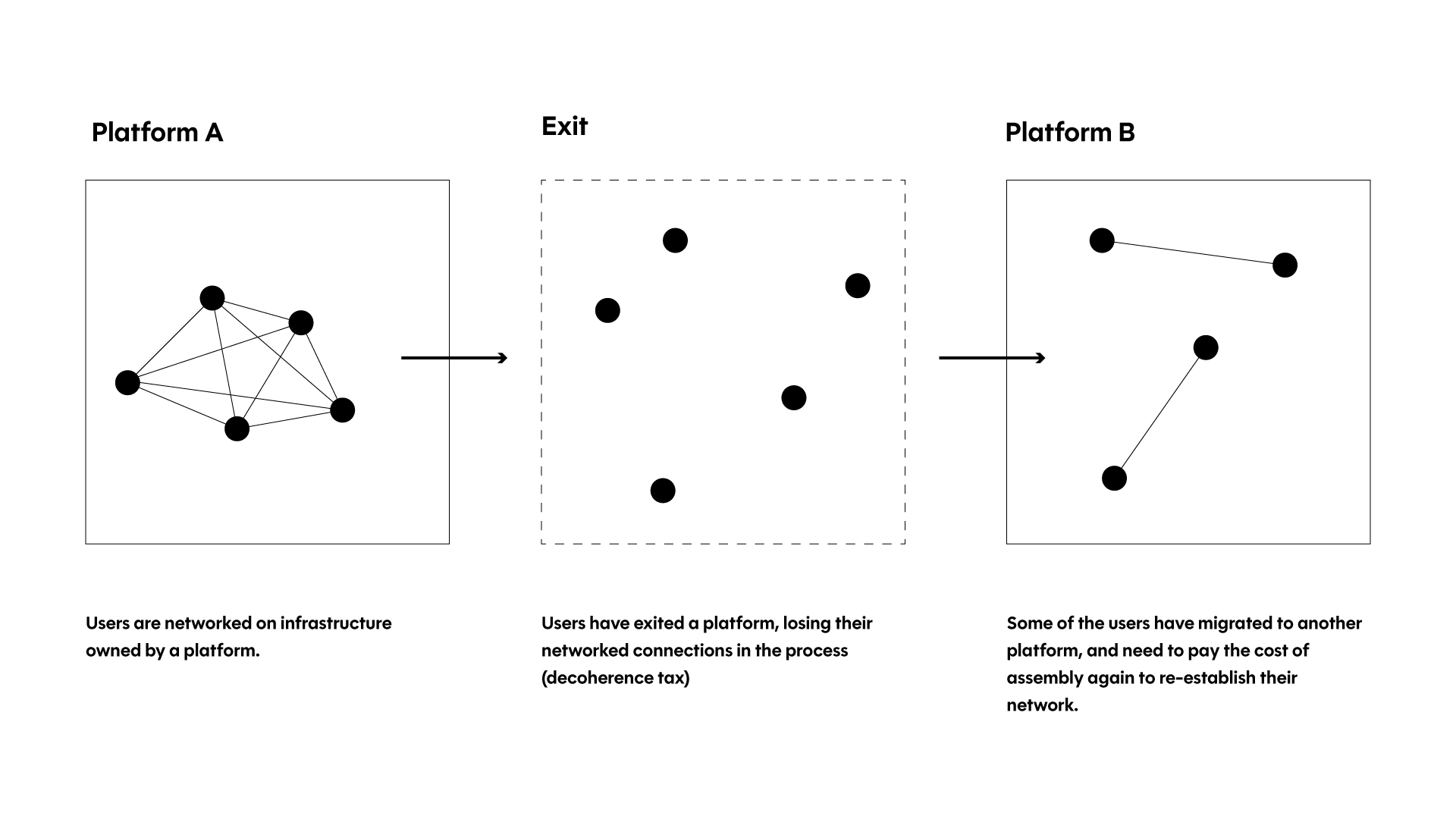
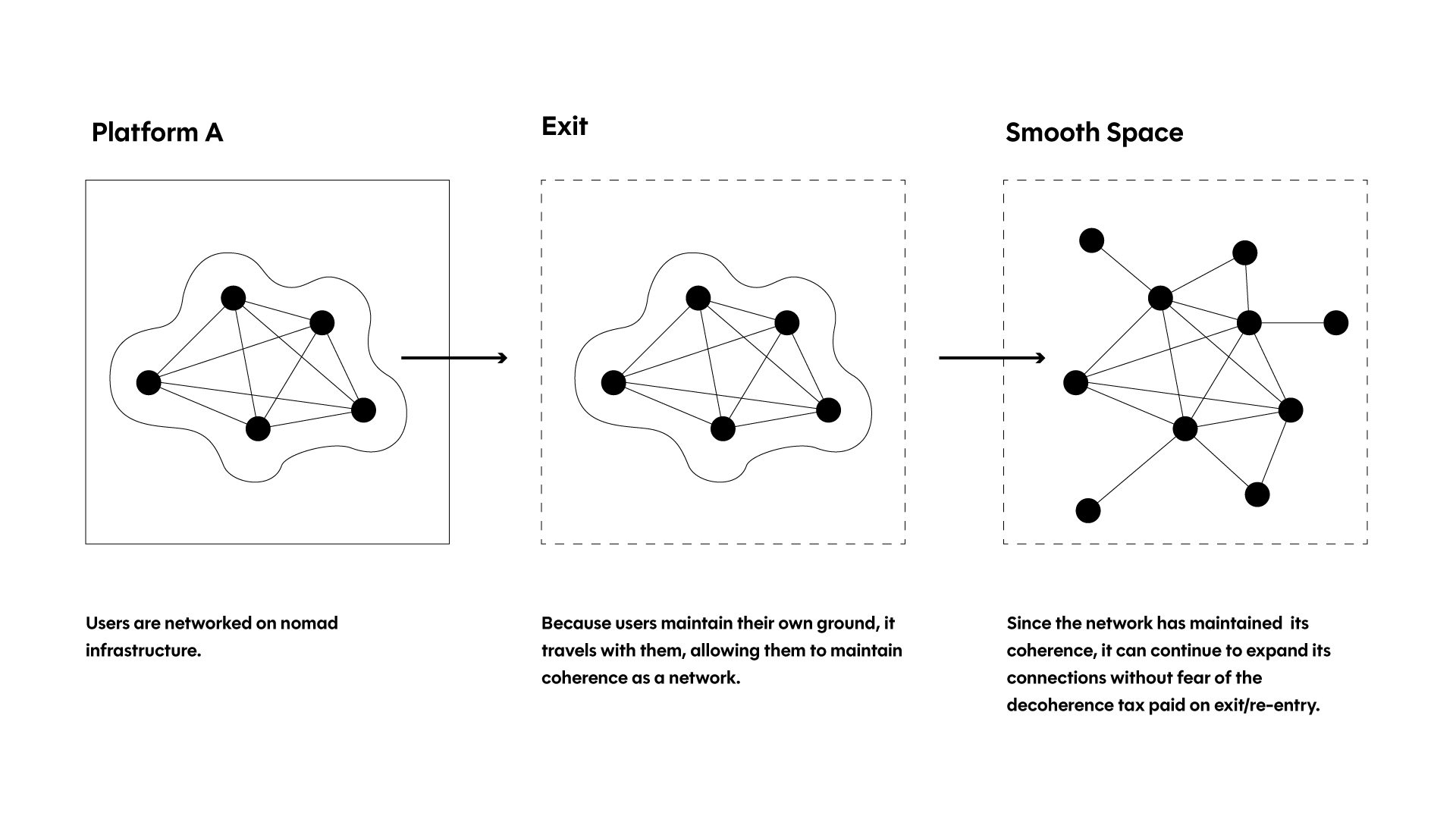
The diagnosis reveals clear areas to focus on, elucidating legible surfaces upon which to act. The nomad web will be engineered for portability and resistance to capture by both capital and preferential attachment, attributes now derived as necessary by the recurring vectors of enclosure observed throughout the internet’s history. And this is where the current internet stands: the protocol web smooth and undefended, captured layer by layer into the platform-State, which now reaches to enclose the interface to relation itself; and against it, a resmoothing already underway, a distributed substrate that has clawed back discovery, the graph, community, and content in parts, but holds no public at scale. The protocol response shows that the technical substrate exists. What is lacking is the connective tissue to make it a legible alternative, and methods to incite collective will to absorb the switching cost and nullify the cold start problem. The mechanism of escape exists in fragments but it does not yet exist as a space to inhabit.
The stakes are not abstract. Crucially the internet is not an immaterial territory and never has been. It is made of the earth, composed of life and silicon, the organic and the inorganic, and is embodied and embedded throughout all of society, to great affect on the earth and its forms of life. It is modernity’s layer of exchange, of information, livelihood, and affectivity. All connection that the internet has enabled has fed back into the material world. Where it was first used to discuss and share research topics, it became the space to discuss music and art; to coordinate work and life; to communicate with coworkers in remote work, and even to organize protests and stage rebellions. All this to say, there are material effects attached to the usage of the internet. It is not separate from society, it has merged within it, becoming a dependency. That capital sees epistemic exchange, socio-cultural production, and affective relation as commodities to extract, rather than a common-ground of life to be cultivated, is the real myopic cataclysm. We make our technology and our technology makes us, climbing an infinite spiral staircase together. Capitalism captures the surplus-value of life, bearing no telos beyond its own reproduction. Through the lens of enshittification, the platform-State can be seen as already dead and the current mass of users living within its decomposing carcass. New life is sprouting from its compost, and starting to spread outside of it, though there are still powerful forces that limit this new growth. The nomad web is an argument about what kind of life the web can and should host. It is, in the end, less a technical specification than a call for cultivation — a claim that the life of the web is a common ground to be tended rather than territory to be enclosed.
We end by circling back to where we began, but now with a view from above. Near the internet’s inception, the Usenet protocol striated itself before the platforms arrived; the commons built its enclosure, the Big Eight, with its own hands. Once we arrive in smoother space we will striate it again. We will desire more structure and start to organize the desert, inventing new modes of production, curation, and governance upon it, and some of what we build will harden. Capital isn’t the cause of enclosure, just its industrialization, a concretization of tendencies. The oscillation from nomad to sedentary and back again never ends, only the ground on which it turns. Within a nomad web, striation must be reversible rather than terminal, every settlement one that can be walked away from without fear of isolation. The protocol web began smooth and undefended; the next web can begin smooth and defended. From the foundation of sound nomad infrastructure there will be new lines of flight revealed to us that are unimaginable from settled space — granted by the open view that can only be found out in the desert.
Imagine a space with an open view, with lines of sight in all directions, from horizon to horizon. In the desert, there are canyons intricately carved out by flowing rivers, and even forests, that imbue an exhilarated sense of enclosed exploration, but there is always a high mesa to climb, offering an expansive view of the terrain in all directions. There may be enclosures, villages and towns, but the gates are always open between them. They are open to all, but attempts at capture are met with defenses at the ready. No one, not even the would-be captors, can be banished to a nether realm. They are free to raise whatever illusory oases they desire, in the outside, but their power of gravity so diminished by the freedom of movement as to be rendered ineffectual. There are simply far too many better better places to be. Places that allow one to be open, without forcing normativity at the threat of exile or capture. It doesn’t have to be a desert. It can be an infinite meadow, a sea, even outer space. The space can take whatever form we imagine which is exactly the capacity of nomad thought. The nomad web does not ensnare imagination, the potentials of life itself, the way the convergent platform-State does; it reveals instead the full field of what is available to us as beings in space, by the trails left in the sand. We will be free to explore — to assemble and disassemble, to settle and traverse, across the open terrain of nomad space.
> but “capture” isn’t synonymous with “evil"
idk man, Project Maven and the Don't Be Evil Deletions feels like a great digital hxc band name for a reason..
kidding (mostly). excellent piece. see u in the protocol wilds